

Air Quality Services
Breathe Better at Home
We test your indoor air first — then recommend only what your home actually needs.
Most homes have air quality problems their owners don't know about.
Dust, pollen, pet dander, VOCs from building materials, combustion gases, humidity imbalances — the air inside your home can be significantly more polluted than the air outside. We measure it first, then build a solution around what we find.
What's in your air?
Common indoor air quality concerns we test for and address.
Dust & Allergens
Dust mites, pollen, pet dander, and mold spores circulate through your HVAC system and settle on every surface.
VOCs & Chemicals
Paints, adhesives, cleaning products, and building materials off-gas volatile organic compounds that accumulate indoors.
Combustion Gases
Gas appliances, fireplaces, and attached garages can introduce CO, NO₂, and other combustion byproducts.
Humidity Imbalance
Too dry and you get static, cracked wood, and respiratory irritation. Too humid and you risk mold growth and dust mite proliferation.
CO₂ & Stale Air
Poor ventilation allows CO₂ to build up, causing fatigue, difficulty concentrating, and reduced sleep quality.
Mold & Dampness
Hidden moisture intrusion and condensation create conditions for mold growth that standard filtration alone won't solve.
Whole-Home Air Filtration
Three tiers of protection — your assessment determines which one fits your home.
Products within each tier are selected based on your specific HVAC system and test results. We carry multiple brands and recommend the right unit for your home, not the most expensive one.
Healthy Air Essential
Proven whole-home particle filtration
MERV 13 media filtration removes the vast majority of dust, pollen, pet dander, and mold spores from your home's air supply. A significant upgrade over standard 1-inch filters with minimal impact on airflow.
- MERV 13 filtration
- Whole-home coverage
- Low maintenance
- Compatible with most HVAC systems
Healthy Air Plus
Enhanced filtration for greater demands
MERV 15/16 or electronic air cleaning for homes with higher filtration needs — allergy sufferers, pet households, or anyone who wants finer particle capture. Removes smaller particles that MERV 13 misses.
- MERV 15/16 or electronic filtration
- Finer particle capture
- Reduced allergen load
- Quieter operation options
Healthy Air Complete
Advanced air quality for the whole home
Our most comprehensive solution combines advanced filtration with VOC and odor treatment, fresh-air ventilation, and humidity control — all sized and configured based on your actual IAQ test results.
- Advanced particle filtration
- VOC & odor treatment
- Fresh-air ventilation
- Humidity management

Whole-Home Humidification
Whole-Home Humidification
The right technology matters more than simply buying the most expensive unit.
Why indoor humidity matters
The EPA recommends keeping indoor relative humidity between 30–50%. When the air in your home is too dry — common in North Texas winters when heating systems run constantly — the effects show up in ways most people don't connect to humidity. Dry air irritates nasal passages and airways, making you more susceptible to respiratory infections. It dries out skin and eyes, causes static electricity, and can crack wood floors, furniture, and trim. For people with asthma or allergies, low humidity can trigger or worsen symptoms. Properly humidified air also feels warmer at lower thermostat settings, which can reduce heating costs.
Why we test before recommending
Before recommending any humidifier, we measure your home's actual relative humidity throughout the day and across different areas. Humidity levels vary by floor, by room, and by time of day — a single reading doesn't tell the whole story. We also evaluate your HVAC system, home size, and construction type, because the right humidifier depends as much on your equipment as on your humidity levels.
Indoor humidity directly affects your comfort, your health, and your home. We measure your home's actual humidity levels before recommending anything — and sometimes the honest answer is that you don't need a humidifier at all.
North Texas note: In North Texas, humidity needs vary significantly by season and by home. Some houses need winter humidification; others actually have a dehumidification problem during parts of the year. We measure first.
Essential
AprilAire 600
Simple, economical humidity control
A bypass evaporative humidifier — simple, proven, and reliable. Works with your furnace's heat to add moisture to the air. Best suited for homes where the HVAC configuration makes bypass operation effective.
- Bypass evaporative design
- Simple and reliable
- Lower equipment cost
- Best for compatible HVAC setups
Enhanced
AprilAire 720A
Higher output with better water efficiency
A fan-powered evaporative humidifier rated at 21 gallons per day. The built-in fan makes it less dependent on furnace cycles than a bypass unit, giving it more consistent output. AprilAire's newer design also reduces wastewater compared to traditional evaporative models — a good fit for our environmental approach.
- Fan-powered for consistent output
- 21 gallons/day capacity
- Reduced wastewater design
- Less dependent on furnace cycles
Precision
AprilAire 800
Steam humidity control for demanding applications
A whole-home steam humidifier that generates humidity independently — no reliance on furnace heat or evaporation. Ideal for large homes, heat pump systems, or customers who need very precise humidity control. Higher equipment and operating costs are the tradeoff for unmatched performance.
- Steam generation — no furnace dependency
- Up to 34.6 gallons/day
- Precise humidity control
- Works with heat pumps and any HVAC type
Sometimes the right answer is no humidifier.
Sometimes the right answer is no humidifier. If your home's humidity is already in the healthy range, we'll tell you — and we won't sell you equipment you don't need.
Whole-Home Dehumidification
Whole-Home Dehumidification
Excess moisture is one of the most damaging — and most overlooked — problems in a home.
Why high humidity is a serious problem
When indoor relative humidity climbs above 50–60%, the consequences go well beyond feeling sticky. High humidity creates ideal conditions for mold and mildew growth — and mold can begin colonizing surfaces within 24–48 hours of sustained moisture exposure. Dust mite populations explode in humid environments; these microscopic pests are one of the most common triggers for asthma and allergic rhinitis. Elevated humidity also accelerates wood rot, causes paint to peel, promotes rust on metal surfaces, and can compromise the structural integrity of your home over time. In North Texas, high indoor humidity is common during spring and fall when outdoor humidity is high but temperatures don't yet justify running the air conditioner continuously.
Why we test before recommending
A single humidity reading doesn't capture the full picture. We measure relative humidity across multiple rooms and floors, check for moisture intrusion points, and assess your HVAC system's dehumidification capacity. Many homes rely entirely on the air conditioner to control humidity — which works well when the AC is running, but leaves the home vulnerable during mild weather when cooling isn't needed. A dedicated whole-home dehumidifier addresses this gap.
Portable dehumidifiers are a common first response to humidity problems, but they have real limitations: they cover only one room, require frequent emptying, and run loudly. A whole-home dehumidifier integrates with your HVAC system to treat all the air in your home continuously and quietly — draining automatically and operating independently of whether the AC is running.
North Texas note: North Texas has a split personality when it comes to humidity. Summers are hot and humid; winters are dry. Spring and fall can bring extended periods of high outdoor humidity without temperatures that justify running the AC. A whole-home dehumidifier handles those shoulder seasons that your air conditioner can't.
AprilAire 1820
Whole-home dehumidification for most applications
A whole-home dehumidifier rated at 70 pints per day, designed to integrate with your existing HVAC ductwork. Operates independently of the air conditioner, so your home stays dry even during mild weather when you're not running the AC. Includes a digital control with humidity display.
- 70 pints/day capacity
- HVAC-integrated, whole-home coverage
- Operates independently of AC
- Auto-drain — no emptying required
- Digital humidity control
AprilAire 1850
High-capacity solution for larger homes
Rated at 95 pints per day, the 1850 is designed for larger homes or spaces with more significant moisture challenges — crawl spaces, finished basements, or homes with persistent humidity problems. Same HVAC integration and auto-drain design as the 1820, with greater capacity.
- 95 pints/day capacity
- Ideal for larger homes and problem spaces
- HVAC-integrated
- Auto-drain
- Handles crawl spaces and basements
Sometimes the right answer is no dehumidifier.
If your home's humidity is already in the healthy 30–50% range and your AC is keeping up, you may not need a dedicated dehumidifier. We'll measure first and tell you honestly what we find.
How the air quality process works
We test your air
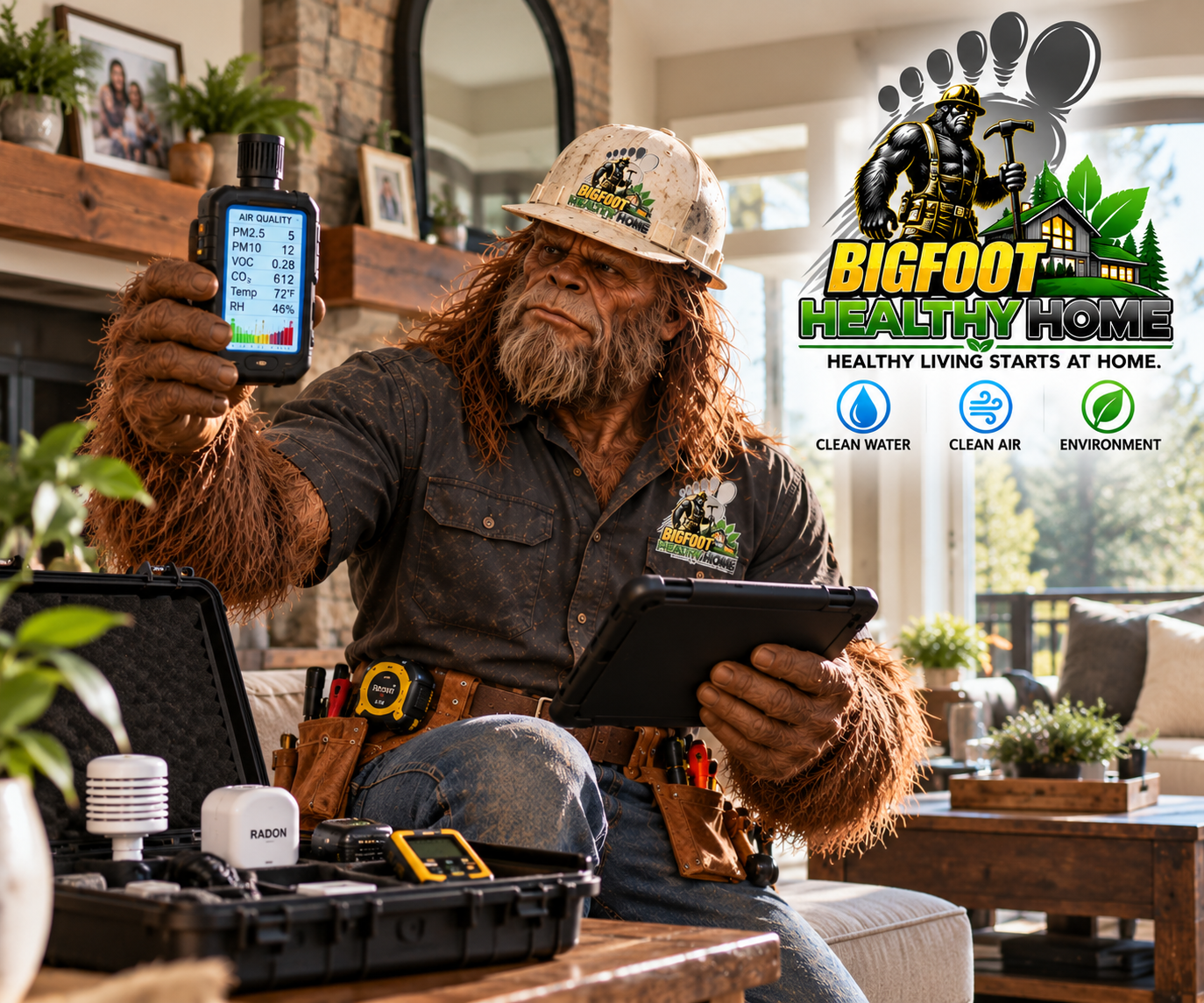
We measure particulates, VOCs, CO₂, CO, humidity, and temperature throughout your home using calibrated instruments.
We review the results with you
We walk through what we found, explain what it means for your family's health, and answer every question.
We recommend only what you need
Our recommendation is based on your test data — not a sales quota. If your air is fine, we'll tell you.
We install and verify
Professional installation by our own technicians, followed by a post-install test to confirm the system is performing as expected.

Start with a free air quality test
No pressure. No obligation. Just honest information about the air your family is breathing.